

FiberSpan™ Resists Slips and Fires
FiberSpan's Slip & Fire Resistance
-
Slippery surfaces are dangerous. People can be hurt in accidental falls, and the financial risks of insurance claims and legal settlements can be high. The obvious answer is to choose a less slippery material. However, conventional materials are limited in their anti-skid properties. An engineered material like FRP can overcome this.
A higher coefficient of friction (μ) means a lower-skid surface. Asphalt and concrete have a 0.7–0.8 μ in dry conditions, a number that is significantly reduced by wet, icy or very dirty conditions. As an engineered material, a nonskid coating can be easily added to FRP before shipping to sites. FiberSpan comes standard with a quartz-based coating that is a 50/50 mix of size 20 and 30 grits to produce a with a 0.97 μ coating. CCG bridge decks can also be ordered with an ultra-resilient aluminum oxide coating (.99 μ) to deliver greater resistance and longevity.
Use Case: Atlanta, Georgia, needed a long-lasting solution for a pedestrian bridge near a public transit station. The bridge would overpass multiple train tracks, so it needed to be both light and sturdy. They selected FRP bridge decking by Creative Composites Group with a Matacryl® surface coating. The bridge’s light weight required less support infrastructure to keep it safely above the tracks, and the ultra-hard Matacryl surface continues to withstand continuous pedestrian traffic.
-
National Fire Protection Association (NFPA) 130-2026 “Standard for Fixed Guideway Transit and Passenger Rail Systems” 5.2.2.1 require certain material “Types” (per NFPA 220-2027 Chapter 4) for different forms of rail construction to ensure proper fire safety. Types I and II are considered “noncombustible” and may be used underground. Steel and concrete are in these categories. Most FRP materials are Type III, which has more use restrictions.
But not all FRP is equal. Some Type III materials can deliver greater fire resistance than others. CCG’s FRP products have been tested for flame spread to ASTM E84 standards and earned a Class 1 rating, indicating that it is a self-extinguishing material. And while CCG’s FRP is most appropriately used in above-ground, open-air applications, we have the capabilities to produce GFRP products with a matrix and resin system that produce much greater fire resistance. For example, our FRP products can be produced with a phenolic resin rated for use in underground subway tunnel shrouds. FiberSpan is typically produced with vinyl ester resin that meets flame spread requirements while still producing minor smoke to serve as an evacuation alert for outdoor rail platforms or bridges.
Use Case: The Atlanta, Georgia, pedestrian overpass bridge near a public transit station suffered a burn (the cause and purpose remain unknown). The self-extinguishing properties of CCG’s FRP meant that the bridge was damaged only in the area of the original flame. While scorching exposed the underlying fiberglass, the total damage was confined to an area less than two feet in diameter. This result meant the customer did not have to replace the entire bridge but could instead repair or replace only the affected area.
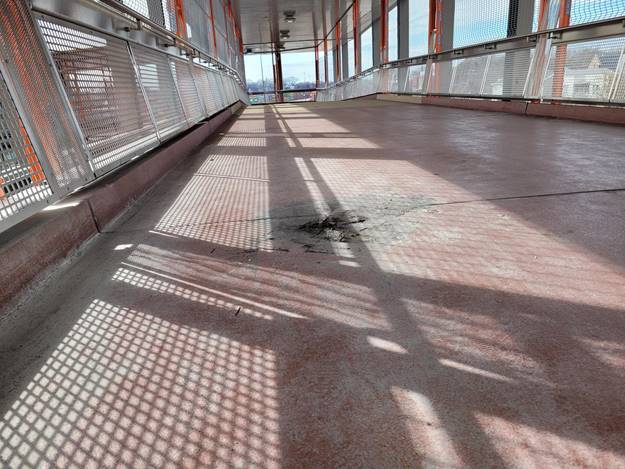
A photograph of the burnt area on the Atlanta pedestrian bridge. The photo is taken from a slight distance to show the isolation of the affected area.