
 Bridges
Modular Pedestrian Bridge Systems
Bridges
Modular Pedestrian Bridge Systems
FIBERGLASS TRUSS BRIDGES
composite bridges for pedestrians, equestrians, bikes and trails
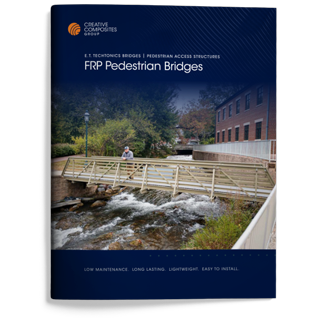
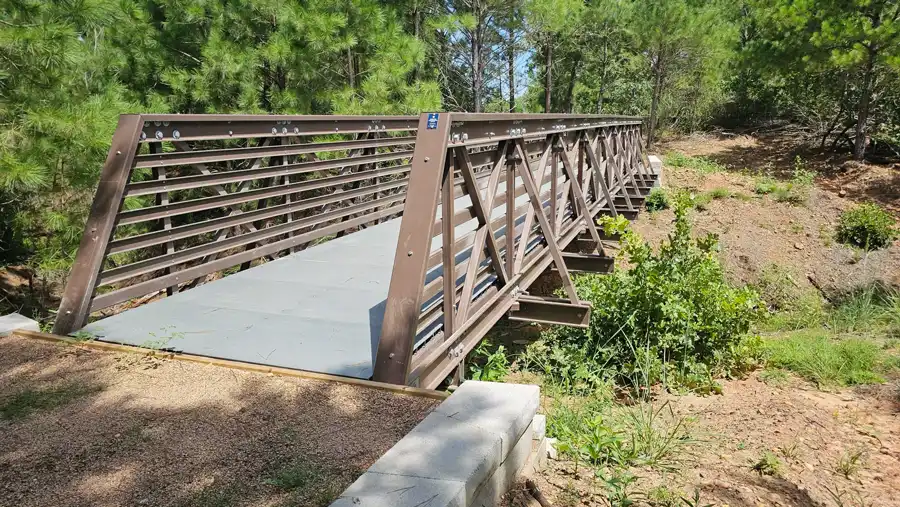
Customers increasingly use Fiberglass Reinforced Polymer (FRP) composite bridges for pedestrian, equestrian, bike, trail and access requirements. We have the right solutions in our standard designs and custom creations. Our E.T. Techtonics brand of fiberglass truss bridges have long been the go-to solution for parks across the United States.
Due to the Nature of our FRP Material, E.T. Techtonics® Fiberglass Truss Bridges Are:
- Long-Lasting
- Low Maintenance
- Lightweight
- Reliable
- Sustainable
- Easy to Assemble
Aesthetically pleasing in natural settings, environmentally friendly, and easy to install, we often supply quality fiberglass pedestrian bridges to national, state and local park agencies.
More resources
Learn more about bridgesE.T. TECHTONICS TRUSS BRIDGES ARE A PERFECT FIT FOR REMOTE LOCATIONS WITH LIMITED ACCESS
Straight Forward Setup
Designed to be a Match
More Maintanable
Better for the Environment
WHERE TO START?
Let us know your FRP truss bridge needs, including span width and length, and we will help you create a long-lasting solution. Our engineers are equipped to help you design to International Building Code (IBC) and the American Association of State Highway and Transportation Officials (ASHTO) specifications. The structural design of our fiberglass bridges is performed in-house by one of our licensed professional engineers in accordance with recognized engineering practices and principles. We design for uniform live loads, snow loads, vehicle loads, wind loads and seismic loads.
Our team is here to review any questions you might have about FRP truss bridges and assist you with your build.
Related Videos
AASHTO Bridge Guide
Frequently Asked Questions
-
Use our free online Request A Quote form to begin the process. Fill in the details and we will work with you to develop an accurate quote for your project. If you prefer, you can visit our contact page to reach us by phone or email. Learn More
-
The schedule from order to delivery is determined on a project by project basis. Use our free online Request A Quote form to give us details about your project. We can put together an estimate for your project that will include scheduling information. Most of our typical spans are shipped within approximately 60 days of order. Learn More
-
CCG does not install these bridges. See our installation guide you can review the different methods of installation. Depending on the type of bridge and the terrain, installation can be performed quickly by a small number of people.
-
E.T. Techtonics park and trail bridges by are typically designed to support pedestrian, bicycle and equestrian uses. They are also often designed to support ATV's, golf carts, and trail maintenance equipment. Our bridges can also be designed for light vehicle applications (10,000 lbs./5T) which includes cars, light pick-up trucks and ambulances. We do not provide vehicular or highway bridges.
-
Components in our bridge system are designed to be hand carried to the site. Usually the heaviest component weighs approximately 90 lbs.
-
Depending on the width the bridge system can be shipped assembled. Most of our clients prefer to have it shipped unassembled as this is the most cost effective approach.
-
Usually we splice bridges over 50'-0" due to shipping. We splice bridges under 50'-0" when requested by the client. Transportation, installation and location typically dictate the most effective component lengths.
-
We have fabricated and shipped 65'-0" long components. Shipping is the major issue and expense when considering components of this length. There is a large cost savings when components of this length are spliced. We recommend splicing.
-
Our longest span to date is 152'.
-
Yes. Note that most cambers require special shop fitting and cambered trusses must be shipped assembled, so this involves additional fabrication costs. Unloading and carrying these assembled trusses may also be more difficult at the jobsite. Assembled trusses for bridges up to 50’-0 in length usually weigh approximately 15 lbs./ft. Bridges over 50’-0 will have spliced truss sections, but due to the heavier components required in the design these sections will weigh approximately 25 lbs./ft. Most of our clients prefer a standard dead load camber only, which can be shipped in component parts for easier transport into remote areas.
-
Standard concrete foundations are typically used with our bridge system. We will provide you a drawing which details the required anchor bolt layout. Anchor bolts can either be cast in place or drilled/epoxied to suit. Clients have also successfully used helical piers with wood or concrete sills, and gabions with wood or concrete sills. We do not provide foundation design, anchor bolts, or soil evaluations. A geotech engineer should be consulted for the foundation design.
-
We have done several bridges of this type. We can discuss the various design options with you and the related costs, if any.
-
In marine type environments and extremely wet environments, we specify stainless steel bolts. We recommend using grade 316SS over 304SS to insure that the fasteners will not exhibit any corrosion.
-
FRP composite decking is available and is ideal for pedestrian bridges located in harsh environments. It is light weight, easy to carry and will withstand the test of time, while providing an ADA compliant slip resistant surface. The most cost-effective decking is standard pressure treated (ACQ) wood. We specify #2 Southern Yellow Pine as this is readily available in our area of the country. We recommend 3"x12" for typical pedestrian and bicycle applications. For equestrian, trail equipment and ATV type applications we use 3"x12". Recycled plastic lumber can also be used as a price point between FRP decking and wood. IPE (hardwood) has been used by our clients on occasions but again at additional cost. Some clients prefer to supply their own deck materials, such as Douglas Fir. For equestrian type applications, we recommend using 3"x12" as horses are sensitive to various textures and sounds of decking.
-
CCG has standardized the spacing at 4". There is no governing standard for trail and park bridge design. For trail bridges the standard maximum opening between horizontal safety midrails is recommended at 9"or less. Typical codes which govern building design recommend a 4"maximum opening for all railings and stairways. Based on this some of our clients specify 4" openings.
-
Fiberglass has similar strength characteristics (tension, compression, bending) to that of steel and aluminum and significantly higher properties in comparison with reinforced concrete and wood. It is 1/5th the weight of steel and 1/2 the weight of aluminum. Its modulus of elasticity is similar to reinforced concrete. Its coefficient of thermal expansion is lower than that of steel and aluminum. Due to its high strength properties it is a viable lightweight alternative to traditional materials of construction with the benefit of being rot and corrosion proof.
-
Fiberglass holds up extremely well in salt air and wet environments and is not affected by termites. Most of our spans, in shady forest locations, exhibit very little change in the appearance of the material over many years. In locations of strong constant sunlight (ultraviolet light) there will be color fading over time, and eventual possible surface deterioration of the material. This does not affect structural performance. We warrant the structural performance of our bridges for 15 years.
-
The fiberglass bridge system is designed to be virtually maintenance-free (a 15-year structural warranty is provided). UV fading will occur over time. The extent is based on the sun's intensity and location.