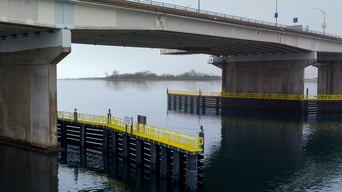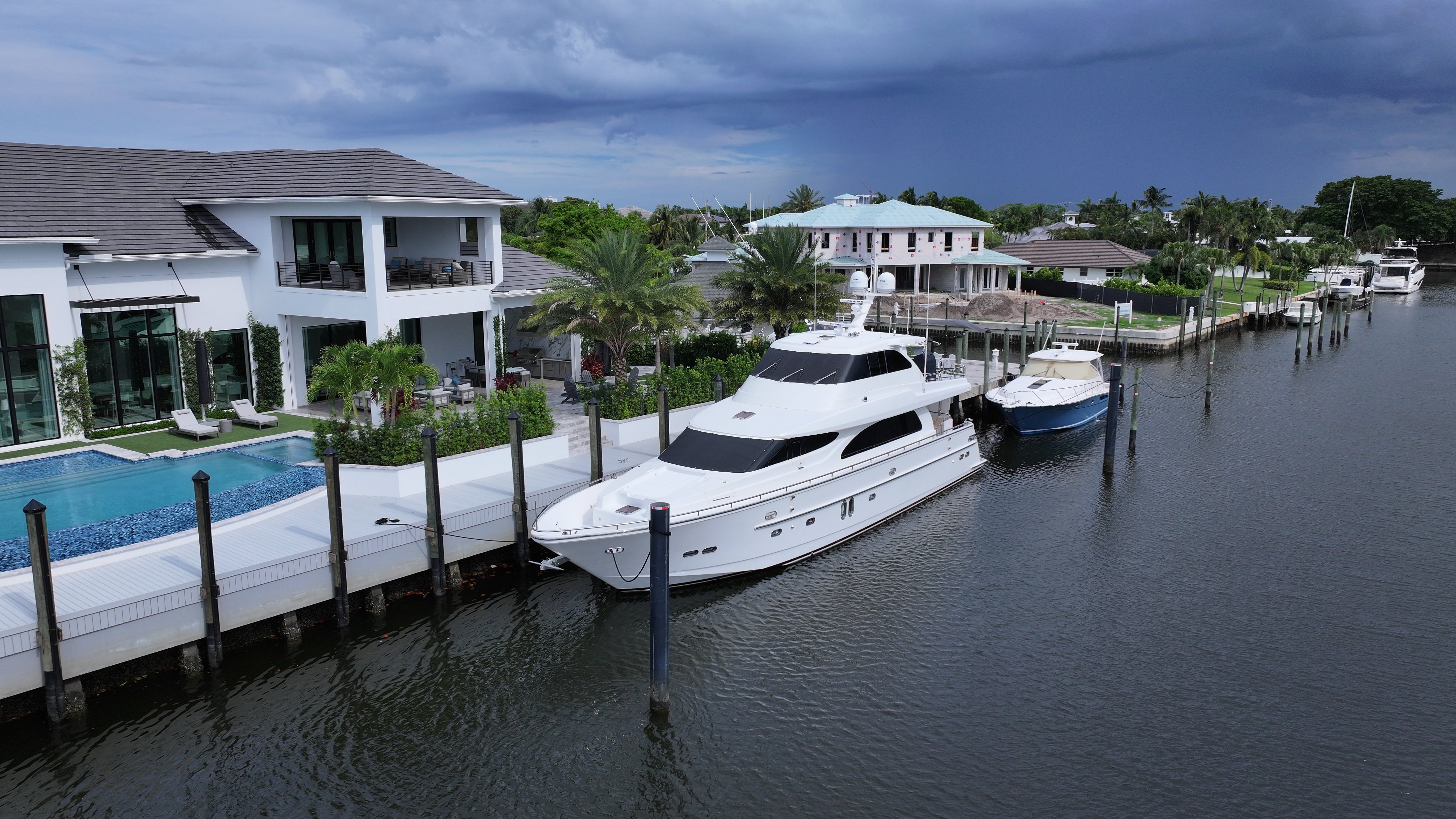

STORMSTRONG® PIPE PILES
Time-Tested Structural FRP Pipe Piles for Waterfront Applications
Many structures and foundations use pipe piles driven into the ground to transfer both lateral and axial loads. The geometry of pipe pilings offers high structural properties, while the hollow pipe makes installation easier. These pipe piles are driven into the ground using industry standard vibratory or impact hammers. The design loads and the soil conditions all determine the pile length and required embedment.
Though traditional pilings are composed of timber, steel and concrete, demand has increased for fiber-reinforced polymer (FRP) composite materials. As a long-lasting and dependable alternative to traditional materials, FRP composite pilings serve as primary elements in various structures, including docks, marinas, ferry landings and waterfront fender protection systems. When chosen as the support option for any number of structural applications, FRP pipe pilings offer extreme versatility and overall cost-efficiency.
More resources
Learn more about pipe pilesBenefits of Structural FRP Pipe Pilings in Marine Applications
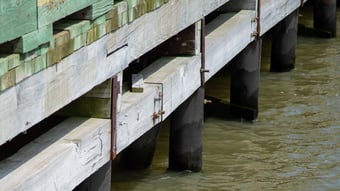
Optimal Support for Waterfront Infrastructure
StormStrong pipe pilings are an excellent choice for heavy load-bearing applications. Structures that bear large loads require a deep, reliable foundation and FRP composite can deliver on the support required for these types of pipe piles.
Excellent Energy Absorption
FRP composite combines high-strength with sufficient flexibility to absorb vessel impacts better than traditional materials. Its low modulus and high strength properties are ideal for protecting structures, especially in applications with commercial barge and ship traffic.
Easy Customization
FRP composite comes pre-fabricated from specialized manufacturing facilities. The pipe pile’s diameter and wall thickness can easily be tailored to suit the needs of your specific application, including exact load requirements, vessel traffic and environmental factors.
Cost Savings
FRP's lightweight nature allows for more accessible and less expensive installations in pile construction. Pre-fabricated in a dedicated facility, FRP piles endure thorough tests and inspections to guarantee optimal structural performance, thereby reducing the potential for costly repairs and replacements. In addition, FRP piles are easily transported and installed, ensuring easy integration into existing construction with minimal replacement costs.
Extreme Weather Protection & Durability
StormStrong weather protection is manufactured to ensure that our engineered structural FRP products protect your infrastructure. Highly corrosion-resistant, FRP composite retains exceptional durability compared to more traditional materials. It is unreactive to moisture or corrosive chemicals and well-suited for use in marine environments. FRP's impervious nature and extreme durability significantly extend the lifetime of the pile in heavy-use marine environments.
Lightweight Strength
Because FRP is much lighter than steel, concrete and wood, it is easier to manufacture, transport and install. Its strength-to-weight ratio ensures optimal support at a fraction of the weight of traditional materials, making it particularly useful for large diameter pipes that are otherwise exceedingly heavy and difficult to maneuver.
Eco-Friendly
FRP is an environmentally safe material, unlike wood, steel and concrete. Because of its chemical inertness, FRP does not release harmful chemicals into the environment. In fact, the New Jersey Department of Environmental Protection (NJDEP) has accepted FRP as an environmentally safe, non-polluting material.
FRP Marine Pipe Piling Products
Our piles consist of high-strength, directional fiberglass within an extremely corrosion-resistant resin. This make-up allows for an exceptionally strong, maintenance-free piling, ideal for withstanding impacts and corrosion on piers and other marine structures.

Pier Piles

Fender Systems

Dock Piles
We provide the largest range of FRP pile sizes and diameters
Available for manufacturing in diameters from 24 to 72 inches and in continuous lengths up to 110 feet, StormStrong piles provide designers the flexibility for optimizing their protection while keeping installation costs low.
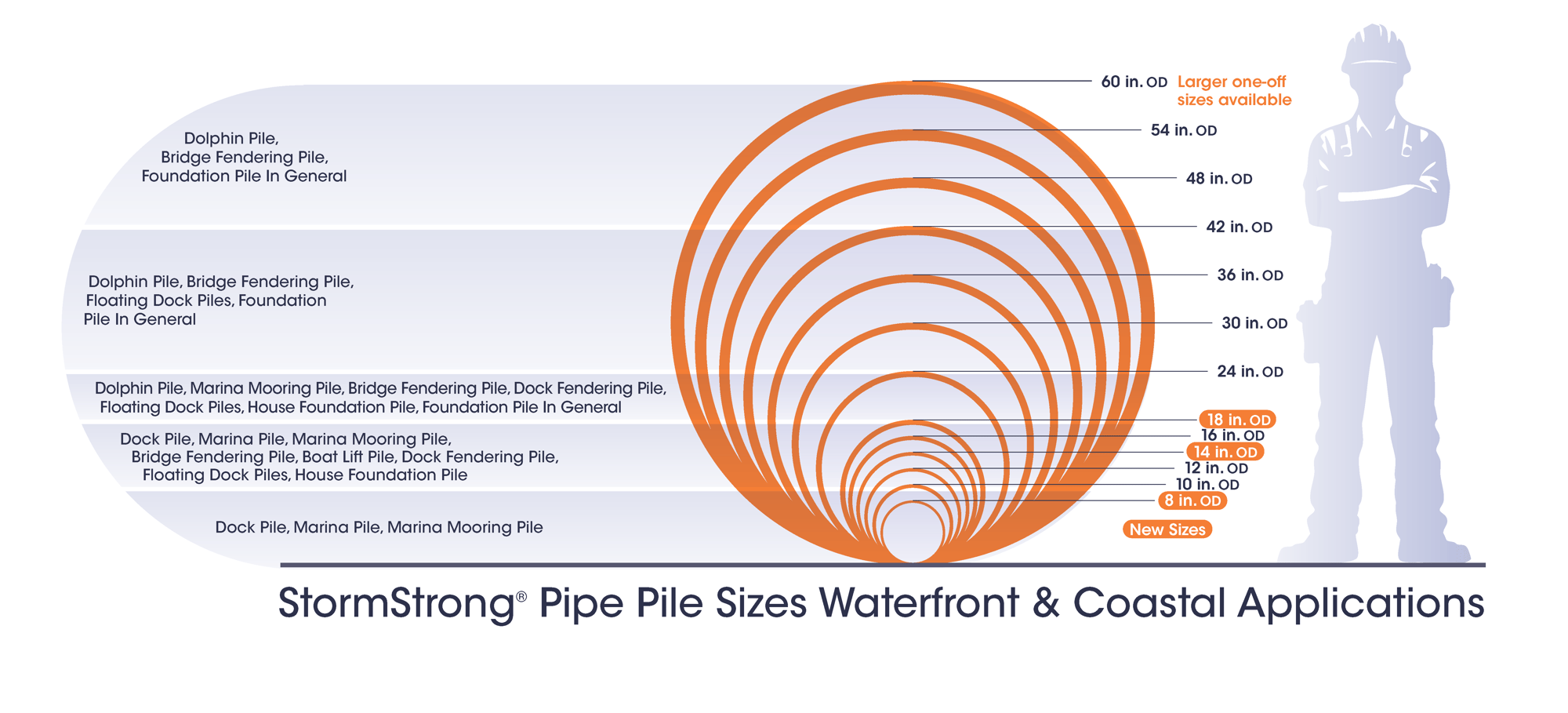
Piles are available in a wide range of thicknesses and diameters:
- Standard OD come as 8", 10", 12", 16", 18”, 24”, 30”, 36”, and 48”
- Piles can be customized for any OD between 18” and 72”
- Typical wall thickness is 3/8” to 1.5”
- Customizable walls range from 1/2” to 2”
StormStrong piles push durability to the next level with electrical-grade fiberglass and high-impact, high-strength polyurethane and vinyl ester resins. This material provides an exceptionally strong pipe with excellent corrosion resistance, meaning fiberglass pipe piles will not rust, rot, corrode or spall. Furthermore, StormStrong piles can be manufactured in smaller diameters and at high production rates.
CCG has developed ideal high-strength, reliable FRP pipe piles for industry standards and construction needs. No matter the specifics of the application, our FRP pipe piles are a versatile option for a wide range of pile construction applications.
Additional Pipe Piling Applications
FRP pipe pilings offer more strength, weight, durability and corrosion resistance than traditional concrete, steel and wood pilings. They can withstand a wide range of environmental and operating conditions that traditionally damage and impair other materials.
Common applications that benefit from FRP pipe pilings include:
- Pier fender systems — Large diameter pilings and wale beams composed of FRP can endure impacts from ships and barges. FRP exhibits the strength of steel but provides a greater level of flexibility for optimal energy absorption in pier fender systems.
- Breasting dolphins — We offer specialized breasting dolphins or structures for ship berthing and mooring. These new FRP structures replace grouped timber piles with one sturdy composite pile while retaining optimal structural reliability.
- Guide walls and slip walls — The flexibility of our FRP piles allows for energy absorption in the event of impact with guide walls and slip walls, for a more reliable and durable structure. These walls bend and recover without breaking, thereby reducing any overall ongoing maintenance for the owner or risk to passengers and vessels.
Related Videos
EIC Associates
Frequently Asked Questions
-
StormStrong piles can be produced in virtually any length required (up to 115 ft in length), limited only by transportation logistics. Common lengths range from 40 ft to 90 ft.
-
StormStrong FRP pipe piles are manufactured in a wide range of diameters to meet structural and geotechnical requirements. Standard diameters include 8", 10", 12", 14", 16", 18", 24", 30", 36", 42", 48" and custom diameters up to 78" are available for engineered projects.
-
StormStrong piles offer:
- Higher stiffness and strength-to-weight ratio than PVC or HDPE piles
- Corrosion immunity compared to steel
- No rot, marine borer or biological degradation compared to timber
- Predictable engineered performance with continuous glass reinforcement
Note: They are engineered structural members — not plastic pipes.
-
StormStrong piles are manufactured with UV-resistant resin systems and protective surfacing veils. They do not chalk, embrittle or degrade like PVC. Long-term outdoor exposure testing shows 50+ years of UV durability with no structural loss.
-
FRP has negligible creep under sustained load because the load is carried by continuous glass fibers, not by the resin alone. This is a major advantage over PVC piles, which exhibit significant long-term deformation under load.
-
Yes. FRP is immune to saltwater corrosion, immune to marine borers and does not rot or rust. This makes StormStrong piles ideal for waterfront, coastal and submerged applications.
-
Creative Composites Group (CCG) provides the following resources for designing with FRP pipe piles:
-
Full engineering design guides
-
Section property tables
-
Soil–structure interaction data
-
Connection details and bolting guidelines
-
Finite element models
-
Direct access to CCG engineering staff for project-specific support
-
-
FRP piles develop skin friction similar to steel pipe piles of the same diameter. Because FRP does not corrode or roughen over time, long‑term capacity is stable and predictable. CCG provides geotechnical interaction data for both driven and jetted installations.
-
StormStrong piles can be installed using the same equipment used for steel or timber piles:
-
Impact hammers
-
Vibratory hammers
-
Jetting
-
Pre‑drilling in dense soils
Their high stiffness and engineered laminate allow them to withstand driving stresses.
-
-
CCG offers:
-
Steel conical tips for dense sands and gravels
-
Open cutting shoes for cobbles or fractured rock
-
-
Use standard lifting slings or spreader bars. Because FRP is lightweight, fewer lifting points are required, but CCG provides recommended lift spacing to prevent bending during handling.
-
FRP can be cut using:
-
Carbide‑tipped circular saws
-
Diamond‑grit blades
-
Reciprocating saws
Cuts are clean and do not splinter when proper blades are used.
-
-
Use standard metal‑working drill bits. FRP drills cleanly and does not crack or split. Hole edges can be sealed with resin if required for marine exposure.
-
FRP connections use torque‑controlled bolting to avoid crushing. CCG provides allowable bearing, shear and torque tables for all standard connection types.
-
Yes. StormStrong piles are engineered structural members that meet or exceed:
-
AASHTO
-
FHWA
-
USACE
-
State DOT requirements for FRP structural components
-
-
No. FRP piles are maintenance‑free, with no painting, coating or corrosion protection required.
-
Yes. FRP piles:
- Do not leach chemicals
- Do not require preservatives
- Have long service life, reducing replacement cycles
- Are recyclable at end‑of‑life
-
StormStrong FRP pipe piles are engineered with continuous E‑glass reinforcement, giving them excellent lateral stiffness and bending capacity. Their high modulus of elasticity allows them to resist lateral loads from waves, currents, berthing impacts and soil pressures without excessive deflection. Full section‑property tables and lateral load design examples are available to support engineering calculations.
-
Axial capacity is governed by a combination of material strength and column buckling. Because FRP has a high strength‑to‑weight ratio and does not corrode or degrade, StormStrong piles maintain their axial capacity over their entire service life. Creative Composites Group provides allowable axial compression values, buckling curves and design charts for all standard diameters.
-
Absolutely. StormStrong FRP piles are engineered structural members designed for axial, lateral and bending loads. They are used in foundations, piers, fender systems, dolphins and waterfront structures where long‑term durability and corrosion resistance are critical.
-
Yes. StormStrong piles include complete engineering documentation such as moment of inertia, section modulus, cross‑sectional area and laminate construction. These values are available in downloadable design guides and can be incorporated directly into structural and geotechnical models.
-
Yes. StormStrong FRP piles are designed to meet or exceed the performance requirements of AASHTO LRFD, FHWA guidelines for deep foundations and U.S. Army Corps of Engineers durability criteria for marine structures. Project‑specific compliance documentation is available upon request.
-
Yes. StormStrong piles can be driven using vibratory hammers, impact hammers or a combination of both. Their engineered laminate structure allows them to withstand driving stresses similar to steel or timber piles.
-
No. Unlike PVC piles, which often rebound due to low stiffness, FRP piles have a high modulus of elasticity and drive smoothly without excessive elastic rebound. This results in more predictable penetration and more accurate driving logs.
-
Yes. StormStrong piles can be field‑spliced using mechanical couplers or bonded sleeves. Splicing allows contractors to achieve long lengths without transportation limitations and is commonly used for deep foundations or marine installations.
-
A standard composite or hardwood pile cushion is typically used to distribute impact loads and protect the pile head. Creative Composites Group provides recommended cushion thicknesses and driving guidelines for each pile diameter.
-
In very dense sands, cobbles or glacial till, pre‑drilling or jetting may be recommended to reduce driving resistance. CCG engineering staff can review geotechnical reports and provide site‑specific installation recommendations.
-
FRP piles should be stored on level ground with adequate support spacing to prevent sagging. Because they are lightweight, they are easy to handle and do not require special blocking or cribbing. Avoid dragging piles across abrasive surfaces.
-
No. Standard slings, chokers or spreader bars can be used. Due to their low weight, fewer lifting points are required compared to steel piles. CCG provides recommended lift spacing for each diameter.
-
FRP piles weigh significantly less than steel and are comparable to or lighter than timber. This reduces equipment requirements, simplifies handling and lowers installation costs. Weight tables for each diameter are available in the product documentation.
-
Yes. FRP is non‑porous and does not absorb water, making it fully resistant to freeze–thaw deterioration. This is a major advantage over concrete and timber piles in cold climates.
-
No. FRP has extremely low water absorption and maintains its mechanical properties even after long‑term submersion. This ensures consistent performance in marine and freshwater environments.
-
No. FRP is completely immune to marine borers, shipworms, gribbles, fungi and other biological organisms that commonly destroy timber piles.
-
FRP is chemically resistant and unaffected by acidic, alkaline or contaminated soils. Unlike steel, it does not corrode, and unlike concrete, it does not degrade in sulfate-rich environments.
-
Yes. FRP is inert and does not leach chemicals into the water. It is approved for use in sensitive marine habitats and environmentally regulated waterfront projects.
-
No. FRP contains no preservatives, no creosote and no toxic additives. It is a clean, non-polluting material suitable for drinking-water applications and aquatic environments.
-
Yes. FRP materials can be mechanically recycled and repurposed into secondary composite products. Their long service life also reduces replacement cycles and overall environmental impact.
-
Initial material cost may be higher than timber or PVC, but FRP piles deliver significant lifecycle savings. They require no maintenance, do not corrode and have a service life exceeding 75–100 years, resulting in lower total ownership cost.
-
StormStrong FRP piles are designed for a 75–100+ year service life in marine environments. Their corrosion-free construction ensures long-term structural performance without coatings or maintenance.
-
No. FRP piles are completely maintenance-free. They do not rust, rot, spall or require painting or protective coatings.
-
Yes. FRP piles are compatible with all common cap materials. Standard bolted, clamped or sleeved connections can be used and CCG provides design details for mixed-material systems.
-
Yes. StormStrong piles are widely used in fender systems, breasting dolphins, guide piles, bulkheads and waterfront infrastructure. Their impact resistance and corrosion immunity make them ideal for these applications.
-
Yes. FRP’s high strain capacity and energy absorption characteristics make it suitable for seismic applications. CCG can provide seismic design guidance and project-specific engineering support.