

FRP COMPOSITE SHEET PILES
StormStrong® Sheet Pile Walls for Waterfront & Marine Applications
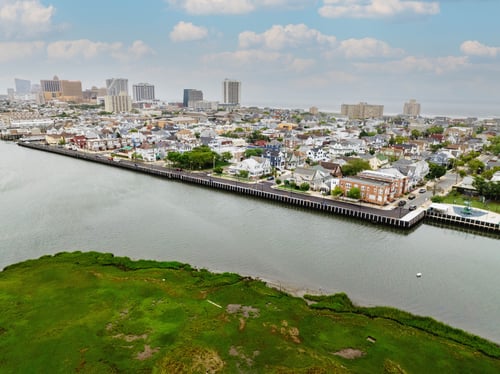
Engineers and owners are constantly looking for the latest technology to provide solutions for waterfront protection, erosion control, landscaping and more. StormStrong FRP materials provide the ideal technology for waterfront application. Whether you need a seawall, bulkhead or retaining wall sheet piling system, FRP sheet piles have decades of successful history withstanding severe weather conditions.
More resources
Learn more about StormStrong sheet pilingArchitectural Beauty Meets StormStrong Durability
FRP composite sheet piling is a great choice if your project requires, weather resistance, high strength-to-weight ratio, corrosion resistance, low maintenance operation and product versatility. The StormStrong sheet pile aids engineers, owners and contractors who are looking for the ideal material for use in almost any infrastructure project. FRP sheet pile walls can be designed for anchored and cantilevered applications.
FRP MARINE SHEET PILE ADVANTAGES:
-
Durable and Affordable — Materials can withstand the toughest conditions. Our composite system includes composite corner connectors, top caps and walers
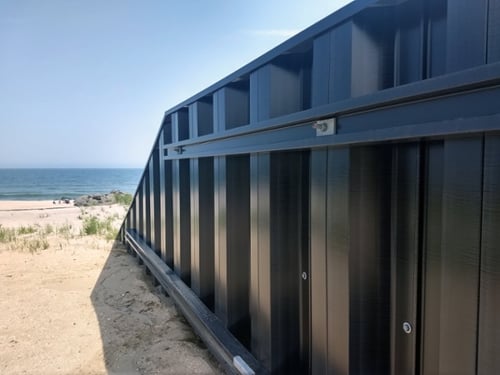
- Long-Lasting — In corrosive environments, while wood is rotting, concrete is spalling, and steel is rusting, FRP is protecting your asset. When properly designed and installed, an FRP wall will last 75+ years based on independent testing and analysis
- Providing Taller Wall Heights — FRP piling has the same benefits as vinyl sheet piling but can achieve taller wall heights. It is more economical to use composites between the 6- and 18-ft wall heights
- Attractive — By using an attractive graphite grey color, the sheet pile blends perfectly with marine applications while a custom color match color can create that one-in-a-million look for your project
- Compatible with Traditional Equipment — Installation options for FRP sheet pile include vibratory hammers, plate compactors and other construction methods
The StormStrong system features sheet pile corner connectors, sheet pile caps, wale splice plates and washers. The accessories were developed to enhance the system and to stand the test of time. Where the environmental considerations require a high strength FRP wale section, SuperWale® can be installed above or below the waterline. The patented profile features a unique shape that allows the tie back rod to recess into the wale section. This feature increases human safety and decreases the possibility of damaging boats or personal watercraft in the event they rub against the FRP wale.
FRP offers a wide range of unique benefits — short production and installation time, long-term cost savings, corrosion resistance and superior longevity. If you are searching for an alternative to traditional materials (wood, concrete, steel, aluminum or vinyl) for sheet piling, please contact us!
Related Videos
J. Fletcher Creamer & Son, Inc.
Frequently Asked Questions
-
Standard metal‑working drill bits can be used to drill FRP. Holes drill cleanly without cracking or delamination. For marine applications, hole edges may be sealed with resin if desired, though it is not structurally required.
-
StormStrong FRP sheet piles can be installed using the same equipment used for steel or vinyl sheet piles, including:
-
Vibratory hammers
-
Impact hammers
-
Excavator‑mounted drivers
-
Jetting (in very dense soils)
Their high stiffness and engineered laminate allow them to withstand driving stresses without cracking or deforming. CCG provides installation guidelines and recommended driving energies for each profile.
-
-
FRP sheet piles can be cut using:
-
Carbide‑tipped circular saws
-
Diamond‑grit blades
-
Reciprocating saws
Cuts are clean and do not splinter when proper blades are used. No special cooling or lubrication is required.
-
-
StormStrong sheet piles can connect to:
- Steel sheet pile walls
- Timber lagging systems
- Concrete caps
- FRP walers and tie‑rods
- Hybrid bulkhead systems
CCG provides connection details, hardware recommendations and design support for mixed‑material systems.
-
The number and spacing of walers depend on:
- Wall height
- Soil pressures
- Surcharge loads
- Tie‑back spacing
- Water level differentials
CCG provides engineering guidance and can review project loads to determine the appropriate waler configuration.
-
StormStrong sheet piles can be used to construct walls ranging from 3 ft to over 20 ft, depending on soil conditions, surcharge loads and tie‑back design. Taller walls typically use:
- Tie‑backs
- Deadman anchors
- Multi‑waler systems
CCG provides design charts and project‑specific engineering support.
-
StormStrong sheet piles are manufactured with UV‑resistant resin systems and protective surfacing veils. They do not chalk, fade or embrittle like vinyl sheet piles. Long‑term outdoor exposure testing shows 50+ years of UV durability with no structural degradation.
-
FRP has negligible creep because the load is carried by continuous glass fibers, not by the resin alone. This is a major advantage over PVC or HDPE sheet piles, which exhibit significant long‑term deformation under sustained loads.
-
Yes. FRP is completely immune to:
- Saltwater corrosion
- Marine borers
- Rot and decay
- Electrochemical attack
- Freeze–thaw cycles
This makes StormStrong sheet piles ideal for long‑term waterfront and coastal applications.
-
No. FRP is non‑porous and has extremely low water absorption. It maintains its mechanical properties even after decades of submersion.
-
Yes. StormStrong sheet piles can be manufactured in a range of colors to match architectural or environmental requirements. Custom colors are available for large projects, and UV‑stable pigments ensure long‑term color retention.
-
Yes. FRP can be produced with surface textures or finishes that mimic wood grain or other aesthetic patterns. This is especially useful for parks, marinas and residential waterfronts.
-
Yes. CCG provides:
- Section modulus
- Moment of inertia
- Bending capacity
- Soil interaction data
- Waler and tie‑back design guidance
- CAD details and BIM files
These resources support engineers in designing retaining walls, bulkheads and flood‑protection systems.
-
Yes. StormStrong sheet piles are engineered structural members capable of resisting:
- Lateral earth pressures
- Hydrostatic loads
- Surcharge loads
- Wave and impact forces
-
Absolutely. FRP sheet piles integrate seamlessly with:
- Steel tie‑rods
- FRP tie‑rods
- Deadman anchors
- Helical anchors
Connection hardware and design details are available.
-
Yes. FRP is inert and does not leach chemicals into soil or water. It contains no creosote, no preservatives and no toxic additives. It is approved for use in environmentally sensitive areas.
-
Yes. FRP can be mechanically recycled and repurposed into secondary composite products. Its long service life also reduces environmental impact by minimizing replacement cycles.
-
FRP sheet piles are lightweight and easy to handle. Standard lifting slings or spreader bars can be used. CCG provides recommended lift spacing to prevent bending during handling.
-
No. They should be stored on level ground with adequate support spacing. Because FRP does not corrode or degrade, no special coverings or coatings are required.
-
Initial material cost may be higher than vinyl, but FRP delivers significant lifecycle savings:
- No corrosion
- No maintenance
- No replacement cycles
- 75–100+ year service life
Compared to steel, FRP eliminates coating, cathodic protection and corrosion‑related repairs.
-
StormStrong sheet piles are designed for a 75–100+ year service life, even in aggressive marine environments.