The United States’ power grid is notoriously outdated, receiving a D+ rating on ASCE’s 2025 Report Card for America’s Infrastructure. The Report Card described the electric grid as “fragile and aging” and under “immense strain” from modern power demands from sources like IoT, AI and data centers. This has left many power utility providers seeking utility pole options that can harden the grid and last for the long term.
Composite utility poles, made of Fiber Reinforced Polymer (FRP), are growing in popularity for grid-hardening and long-lasting performance. Composites are lighter than equivalent sizes of steel, much more flexible than concrete and innately more resistant to the elements than wood. FRP poles are corrosion-resistant, making them perfect for humid and coastal installations, do not rely on chemicals that can leach into the surrounding environment and resistant to destruction by animals like woodpeckers, beavers and elk. This lighter-weight pole material can enable crews to speed up pole replacement, minimize traffic disruptions and minimize road closures during replacements, especially in congested urban areas. The lower-weight pole also enables easier delivery and installation of poles to that are remote, mountainous, rural areas and other difficult-to-access locations and enables crane-free installation.
Here’s how to install FRP utility poles are installed.
What Crews Need to Install Composite Poles
Those looking to replace wood poles with composite poles will not need any special installation equipment. Crews can usually install composite poles using the same equipment used for wood poles. In fact, the lighter weight of FRP poles can reduce installation equipment and crew size requirements.
The differences are mainly in handling before and during setting. Composite poles are relatively lightweight and many designs are not tapered like a wood pole, both of which can affect the pole’s center of gravity during lifting. The smooth outside surface of the pole also requires higher-friction straps when moving the poles.
Crews installing composite poles need:
- Digger derrick truck with auger and boom
- Aerial lift device (bucket truck)
- Drill with carbide tip drill bit (such as Milwaukee brand)
- Pole washers
- Bolts
- Self-driving screws
- Torque wrench
- Neoprene-coated nylon straps
- Metal steps (optional)
Steps to Install Composite Utility Poles
1. Prepare the Pole.
Only light PPE (long sleeves and gloves) protects crews from the “nuisance dust” produced by drilling a composite pole. No special PPE like respirators is required.
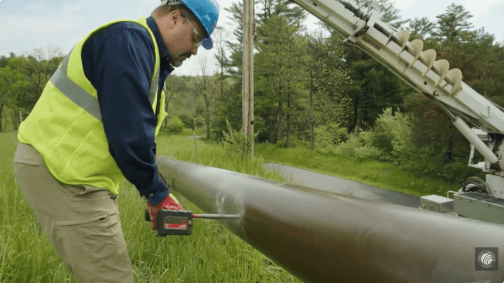
Drill neutral bracket holes by positioning the drill at about 90°, drilling on a fast speed at the beginning and slowing down slightly to relieve some pressure when pushing through into the pole’s hollow center.
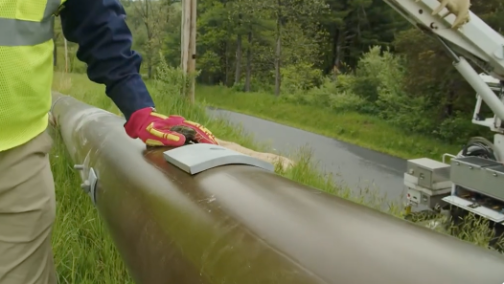
Always select washers that match the radius of the pole. The correct washer will fit snugly against the outside diameter with no pronounced gaps. A heavy-duty washer should be used if the pole will be guyed.
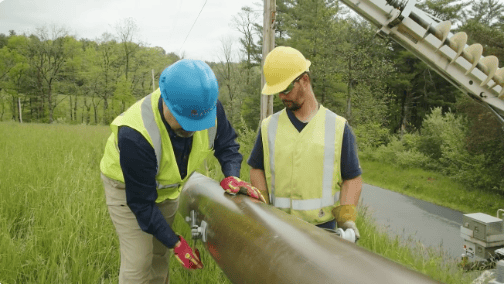
Don’t over-torque bolts when attaching hardware to a pultruded pole. Because fiberglass poles do not expand and contract due to moisture uptake like wood poles, a spring washer attached with 20 to 23 foot-pounds of torque, tightened until the spring washer collapses, is suitable for a secure connection.
Because composite poles are hollow, ground wiring may be installed either along the outside of the pole, just like a wood pole, or through the center. Feeding the ground wires through the center can help deter theft of valuable copper. Utilities choosing to attach grounding wires to the pole’s exterior should use self-drilling screws and ground wire clips. Space the clips every 12 inches, and avoid over-tightening the screws.
Watch the full video clips:
- How to Drill Holes for Brackets
- How to Select Washers
- How to Tighten Nuts
- How to Attach Ground Wire Clips
2. Auger the burial hole.
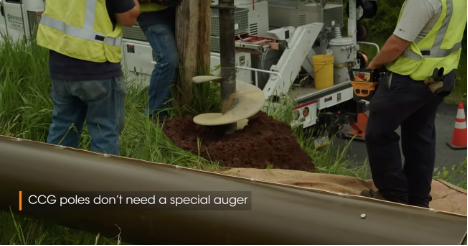
FRP poles by manufacturers like Creative Composites Group do not require a special auger for installation. These composite poles use same auger on a standard digger derrick as wood poles. FRP poles use the same burial depth as wood poles (10% of the pole length plus two feet).
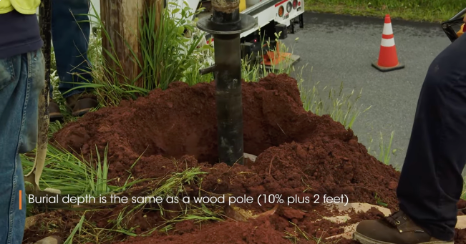
3. Choke the pole for lifting.
Unlike wood and concrete poles which have a naturally higher surface coefficient of friction, composite poles are naturally extremely smooth. Line crews can avoid slippage by choking the pole with a neoprene-coated nylon strap, which grips the pole and keeps it from slipping as it’s lifted.
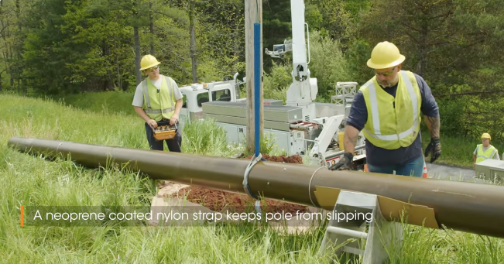
Watch the full video clip: How to Use Nylon Choker
4. Set the pole.
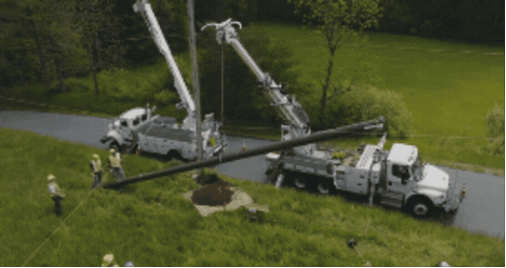
FRP poles are lightweight enough that the poles can often be moved by hand by line crews. Shorter poles (around 20 feet tall) can even be lifted to vertical manually. Most utilities choose to lift composite poles using a digger derrick boom. No specialized or heavy-duty cranes are needed. This is a particular advantage for utilities performing installations in hard-to-access and remote areas.
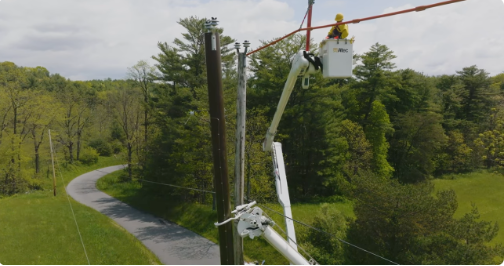
Watch the full video: How to Set an FRP Pole
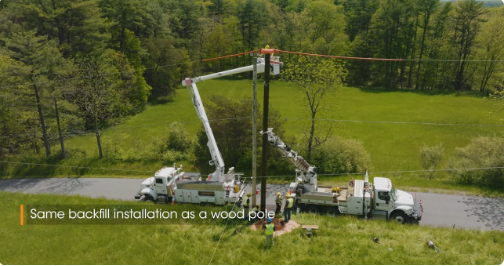
5. Backfill the hole.
The same backfill installation practices as any wood pole are used for composite poles.
6. Transfer the utilities and wiring.
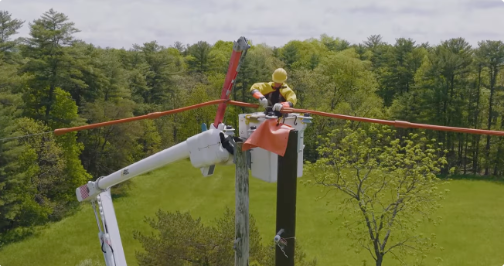
Once the pole is securely upright, line crews may transfer the utilities and wiring from the old pole to the new, using all approved safety protocols.
Composites Help Strengthen Grids
Line crews are experiencing an installation process for Fiber Reinforced Polymer utility poles that is very similar to wood and, in some ways, is simpler. And utility providers like Ameren and Clallum PUD are proving that a switch to composite poles in high-outage-risk areas or choosing a staggered installation (one composite pole integrated at intervals between wood poles) can substantially reduce outages, especially cascading outages, that negatively impact customers and line crews. Learn about the pros and cons of different pole materials, and contact us to see the impact composite poles could make in your area.