
Fiber Reinforced Polymer (FRP) bridge deck projects in Hamilton, Ohio demonstrated the advantages of large-scale composite molded panels for rail platforms.
WHY THE RAIL/TRANSIT INDUSTRY HAS ADOPTED FRP PLATFORMS—ORIGIN STORY
In the late 2000s, Chicago METRA started using FRP platforms. The NYC Metropolitan Transportation Authority in Queens, New York received the first FRP rail platform for Court Square Station in 2012. More than a decade later several US transit agencies including Chicago METRA, the Massachusetts Bay Transportation Authority [Chelsea Station, Boston], and the Southeastern Pennsylvania Transportation Authority in Philadelphia [Wayne Junction] have adopted FRP rail platforms for two reasons: light weight and longevity. The ability to replace deteriorated concrete with corrosion-resistant, prefabricated panels for overnight installation with minimal impact on train schedules is another key driver behind the growing trend in the U.S. transit sector. Recently Creative Composite Group’s Scott Reeve, Gregg Blazak and Brandon Weyant decided to ride the rail and see firsthand how the company’s newest FRP platforms—installed between 2020 and 2025—are performing.
PROLOGUE
The team visited stations on various lines in the Boston area and travelled on the South Coast Rail (SCR) service from Boston. The line forms a “Y” from East Taunton with one branch going to Fall River and the other to New Bedford. All of the platforms were prefabricated with CCG’s Double Tee product. Slab panels were used for ramps and areas around elevators. The platforms featured railings and appurtenances such as benches, signs and fare machines attached directly to the FRP panels. Seven of the 11 platforms featured the same basic design for side platforms: straight tee panels edged with ADA safety tactiles on concrete piers along one track. The other four specified more complex configurations and unique features. For most of the projects, the FRP panels were installed quickly at night to reduce train schedule disruptions. MBTA project managers said the platforms looked great and were especially excited about the fast installation the panels made possible. Visual inspections revealed no issues. Joint sealants and adhesive bonds on FRP rail platforms are the most vulnerable component to environmental degradation and can require future maintenance. Overall, 99 percent of the joint sealants on the platforms visited by the team passed inspection.
FIRST STOP: CHELSEA STATION
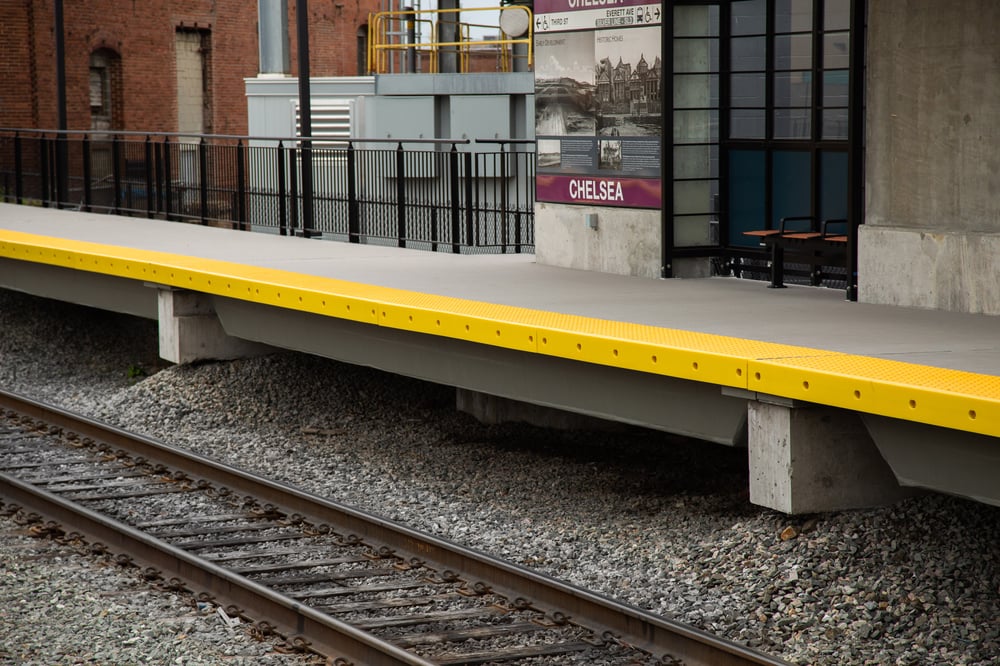
Before boarding the train to inspect the other rail platforms along the route, the team first took a look at Chelsea Rail Station in Massachusetts. Installed in 2020, CCG replaced an outdated station platform with two durable, corrosion-resistant FRP platforms with ADA accessibility, and integrated amenities like shelters, benches, lighting, sidewalks and passenger-assistance phones. The modern structure improved transfers for commuters. Each FRP platform was 800 ft. long. Lessons learned from the early installations prompted CCG to implement a more expandable joint sealant and improve the application process. The inspection showed the seals were in good condition. One customer commented that the platform still looked new.
ALL ABOARD
The team boarded the South Coast Rail (SCR) extended rider service from Boston to visit six new stations, each of which featured an FRP composite platform. For Middleborough Station [the first stop], CCG prefabricated custom slip-resistant FRP panels to fit the station’s unique curved track. ADA-compliant yellow strips, a crowned profile for water runoff and a slip-resistant surface were specified for the 800-ft. platform. By matching the curved panels to the track, the correct gap between the train and the platform was maintained.
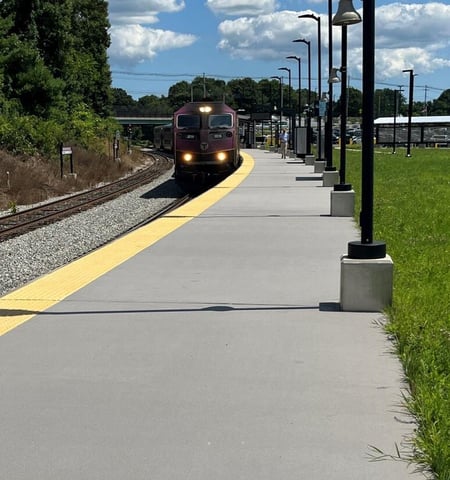 At the second stop, the team examined one of the largest stations in East Taunton. The FRP platform was 1,600 ft. long and 26.5 ft. wide. Installed between two tracks, the center platform was accessed by stairs, elevators and ramps. The ramps were also prefabricated with FRP.
The FRP rail platforms at the third and fourth stops were similar in shape and size. Church Street Station’s composite platform used Double Tee panels 32 ft. long and 12 ft. wide for a total length of 800 ft. Some of the panels had cutouts for canopy supports. New Bedford Station’s FRP rail platform was also 800 ft. long and 12 ft. wide. Due to the station’s elevation a retaining wall at the back edge of the platform was added to prevent access to the tracks.
DON’T MISS THE FINAL LEG OF THE TRAIN RIDE
Don’t miss our next blog which follows the team on the second leg of their trip as they ride the other branch of the SCR line. SCR underwent one of the most significant updates in modern history with the restoration of passenger rail service to Boston after nearly 70 years. The opening of South Coast Rail, now called the Fall River/New Bedford Line took more than three decades and approximately $1 billion to bring to fruition. FRP played a part in helping MBTA reconnect Fall River, New Bedford and Taunton.