
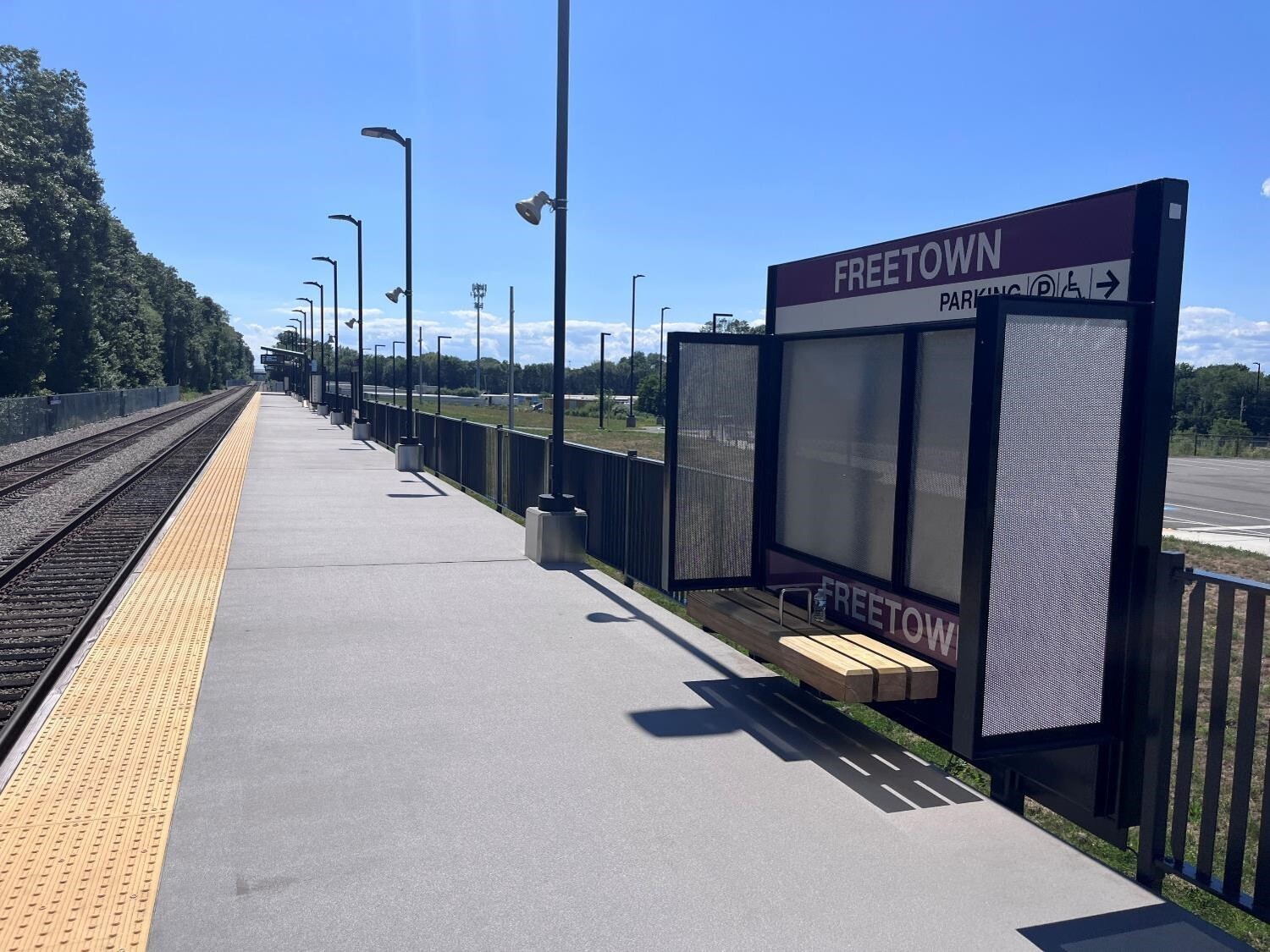
Following Phase 1 construction, SCR’s new line re-opened service in March 2025 with new stations like Freetown and Fall River were installed between 2022 and 2024.
FRP PLATFORMS HAVE BECOME A COMMON FIXTURE AT RAIL STATIONS
FRP platforms have become a common feature of the Massachusetts Bay Transportation Authority (MBTA) which provides subway lines, buses, commuter rail and ferries to 78 municipalities. Worchester Union Station saw the installation of FRP platforms, followed by Winchester with Natick [on the Farmington/Worcester Line] just finishing up. CCG team members Scott Reeve, Gregg Blazak and Brandon Weyant travelled to one of the nation’s oldest transit networks when they boarded the SCR line on the other side of the tracks to take a look at six FRP rail platforms. Each passed visual inspection. Platform joint sealants and adhesive bonds also passed.
BEHIND THE SCENES
The MBTA’s Fall River/New Bedford Commuter Rail line serves stations such as Fall River and Freetown which are part of the new extension. The added service can cut commute times to Boston and offers a car-free alternative to I-24/I-93. Ridership has seen an overall increase of 33 percent [2,000-plus daily trips]. A 36 percent increase in weekday commuters and 13 percent weekend growth were tracked from April to September 2025. In December 2025 MBTA estimated the SCR line provides an average of 10,240 rides per day.
PLEASE STAND CLEAR, THE TRAIN IS NOW DEPARTING
The team boarded at the Freetown SCR Rail Station. Located at 153 South Main Street in Assonet, the new rail stop features a single-sided FRP platform. The second stop was Fall River Depot at 825 Davol Street in Fall River. The modern facility has parking, bike spaces and SRTA bus connections. Both Freetown and Fall River’s composite platforms are 800 ft. long and 12 ft. wide. To meet the contractor’s schedule for the Freetown installation, half of the panels were manufactured at CCG’s Dayton, Ohio molding facility and the other half at the facility in Augusta, Maine. Riders said they could not tell any difference between the panel sets, a fact the CCG team was proud of.
Located north of central Boston, Maiden Center Station became a candidate for FRP when the concrete edge on its existing platform began to deteriorate. Instead of replacing the main platform structure which was in reasonable shape, the customer chose to replace the concrete edge with FRP panels. The composite material’s light weight made it simple for contractors to attach the FRP edge panels to the platform. The overall length of the FRP edge panels was 384 ft., with individual panels running 25 ft. long and 30 in. wide with tactile covering most of the surface.
HISTORIC RENOVATION
The team travelled west to Worcester Union Station next. Classified as an historic Beaux-Arts style transportation hub in downtown Worcester, it serves as a key intermodal center for the MBTA’s commuter rail to Boston. In the late 1990s the station underwent a $32 million renovation and reopened to the public in 2000. The 775-ft.-long FRP center platform allows two trains to operate simultaneously. One section of the platform acts as a bridge over the street below. About one-third of the platform follows a curved track. Panels were prefabricated for cutouts to accommodate canopy supports along the platform’s centerline. Because the platform is elevated, it required switchback ramps which were also prefabricated with FRP. The ramps were 715 ft. long and 733 ft. long respectively. The elevated platform panels were also equipped with curbs and drain scuppers to control water runoff.
FINAL DESTINATION
The Natick train station in Massachusetts is a key stop on the MBTA’s Framingham/Worcester Commuter Rail line connecting Boston and Worcester. Sitting below street level in a stone-lined canyon, the station required FRP platforms on both sides of the track. Each platform is 770 ft. long. Ramps [640 ft. long] carry commuters to the platforms. A pedestrian bridge with FRP decking crosses the station to streamline movement between the two platforms.
The FRP composite platforms the CCG team was able to observe have proved that FRP is a versatile, durable choice for transit services that need pedestrian decking and platforms that can resist harsh weather and withstand the wear-and-tear of heavy commuter traffic. If you need an upgrade or are part of a renovation project and need a rail platform that is lightweight, quick to install and requires no maintenance, call us or email us. We would love to talk with you about your needs.